

Designing a Beer From the Finished Glass Backwards (Part 1)

Updated: Apr 16

Everybody knows that beer is made using four basic ingredients, water, malt, hops and yeast, and i'm sure most know that recipe design is not as simple as just mixing these ingredients.
For me, it usually starts somewhere else. It starts with an idea of the finished beer.
Before I begin writing a recipe, I’m usually trying to picture the beer in the glass. What colour is it? How does it smell? What does the carbonation feel like? How does it hit the palate? Is it soft and rounded, or bright and sharp? Is it light and refreshing, or layered and contemplative? From there, I work backwards.
That’s how most of my recipe design happens.
Starting With an Idea
In this case, the idea was a white tea saison.
We already use organic white tea in our kombucha, and it brings a really delicate, floral character that I’ve always liked. Saison, when handled well, can also carry subtle floral, peppery and expressive fermentation notes.
That overlap got me thinking: why not bring the two together?
The goal became to create a beer that would showcase those fine, subtle white tea flavours without overwhelming them. That immediately pointed me toward a lighter, mid-strength saison, something delicate, refreshing and highly drinkable, but still interesting.
It also felt like the right time for it. Wild Barrel has never really had a mid-strength beer in the range, and it seemed like a good opportunity to create something that complements what we already do while offering something a little different.

Imagining the Finished Beer
Once the concept is there, the next step is to imagine the beer as clearly as possible.
For me, that means asking questions like:
What should the beer look like in the glass?
How much body should it have?
How lively should the carbonation be?
Should it feel crisp and dry, or softer and rounder?
How prominent should the tea be?
How much saison character do I want from the yeast?
How much bitterness is enough to balance the beer without distracting from the more delicate flavours?
That vision is what guides the recipe.
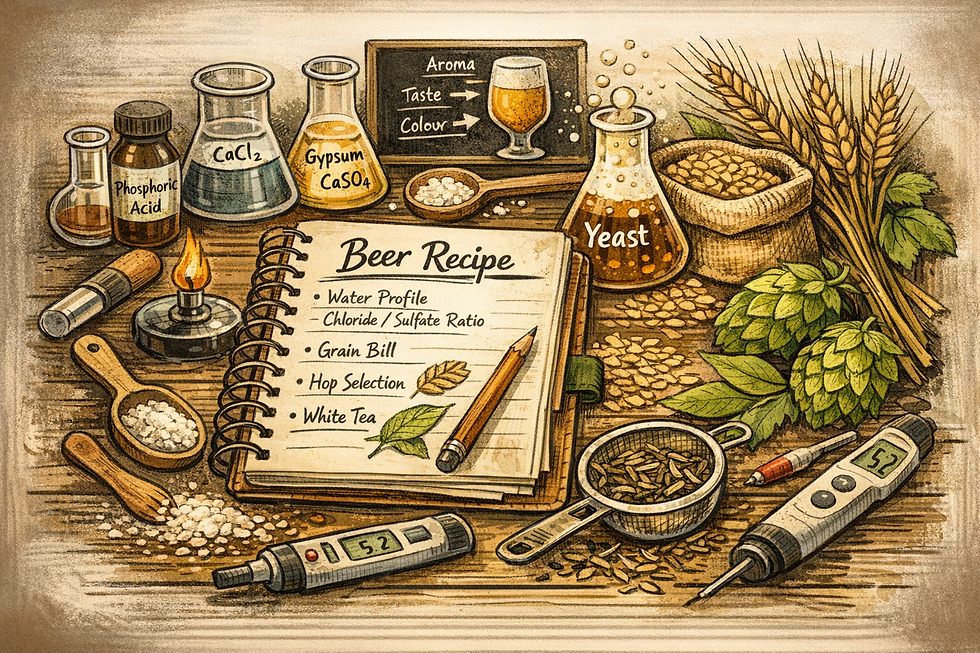
Because every choice from that point on, water chemistry, grain bill, mash temperature, hopping schedule, fermentation time and temp and final pH, is really just a way of trying to move the beer closer to that imagined result.
Building the Beer Piece by Piece
Water chemistry
Water has a huge influence on how a beer feels and drinks.
It affects mouthfeel, bitterness, dryness and how flavours present on the palate. If I want a beer to feel crisp and lean, I might push the water profile in one direction. If I want something softer and rounder, I’ll approach it differently.
For a lighter saison with white tea, the water needs to support delicacy rather than heaviness. It’s not just about flavour, it’s about texture and balance.
Grain bill
The grain bill sets the foundation.
With a beer like this, I’m not looking for a heavy malt profile or lots of sweetness. I want a base that supports the yeast and tea, while still giving the beer enough structure to feel complete. That means thinking carefully about which grains to use, how much body I want, and how dry I want the finish to be.
Mash temperature
Mash temperature plays a major role in determining fermentability, which in turn affects body and alcohol. If I want a beer to finish drier and lighter, the mash needs to support that. If I want more fullness and residual body, I approach it differently.
In a mid-strength beer, this becomes even more important because you’re trying to create flavour and structure while keeping the alcohol lower.
Hops
Hops are another part of the puzzle, but in a beer like this they need to complement rather than dominate.
The question isn’t just which hops to use, but also when to use them.
Early additions will give more bitterness. Later additions can bring more aroma and softer flavour expression. For a delicate saison built around white tea, the hop choice and timing need to support the beer quietly, not steal attention from the yeast and tea.
Tea addition
Then there’s the tea itself.
How much do you use? At what stage do you add it? How do you extract flavour without pulling too much bitterness or astringency?
That’s a big part of the design process too. White tea is subtle, which is exactly what makes it interesting, but also what makes it easy to overpower if the beer around it is too bold.
pH
pH is one of those things that can dramatically shape how a beer is perceived, even if most drinkers never realise it.
A lower pH can make a beer feel brighter, leaner and a little sharper. A higher pH can make it feel softer and rounder. Final beer pH plays a major role in how the beer lands on the palate, especially in lighter styles where small shifts can be more noticeable.
Recipe Design Is Really About Balance
When designing a beer, all of these elements need to work together.
You’re not just choosing ingredients. You’re shaping:
flavour
aroma
texture
balance
appearance
drinkability
That’s what makes recipe design so interesting. Every decision affects something else.
The grain bill affects body. The mash affects fermentability. The water affects mouthfeel. The yeast affects aroma and flavour. The pH affects how sharp or soft the beer feels. The hops can either support the beer or completely change its direction.
So when I design a recipe, I’m really trying to line up all of those moving parts to produce the beer I first imagined in my head.
Starting With the Beer, Not the Recipe
For me, the process always comes back to the same thing:
Start with the beer you want to drink. Picture it clearly. Think about how you want it to look, smell and feel. Then work backwards through every stage of the brewing process to give yourself the best chance of creating it. That’s what recipe design is.
Not just writing down ingredients, but translating an idea into a finished beer.
And with something like this white tea saison, that process becomes even more interesting, because the goal isn’t just to make a beer, but to make one that carries delicacy, balance and intention from the first sip to the last.


Comments