

Designing the White Tea Saison: The Practical Build (part 2)

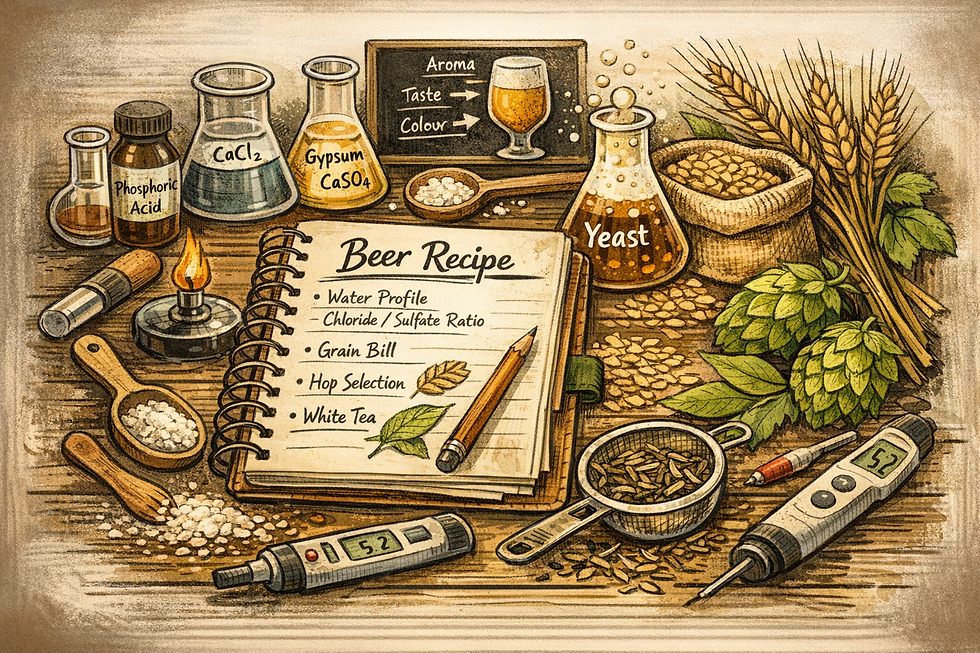
In Part 1, I talked about starting with the finished beer and working backwards.
This is where that process becomes real, turning an idea into actual brewing decisions.
Water Chemistry: Setting the Structure
A big part of how a beer presents comes down to the chloride-to-sulfate ratio.
This ratio helps shape how the beer feels and which flavours are emphasised:
Higher sulfate (calcium sulfate / gypsum) → accentuates hop bitterness and dryness
Higher chloride (calcium chloride) → enhances fullness, softness and malt perception
For this beer, I’ve kept things fairly balanced, because I don’t want it leaning too far in either direction. It’s not a hop-driven beer, but I also don’t want it feeling heavy or overly rounded.
The goal is:
light but not thin
soft but still crisp
structured without being heavy
I’ve also added a small amount of Epsom salt (magnesium sulfate), this will help round out the mineral profile and support yeast health. In small amounts it can subtly contribute to mouthfeel and dryness. Because we’ve had our water lab analysed, I can use software to dial this in pretty precisely and build the profile to suit the beer.
Mash pH: Enzyme Performance and Balance
Mash pH is critical.
For proper enzyme activity during conversion, you generally want to be in the range of:
5.2 – 5.6
I’ll typically bring that down using a small amount of phosphoric acid in my strike water (clean water before mashing in) just to get it into that optimal range. I adjust PH again before transfering so I hit my desired finished beer PH. Beer will generally drop around a full point during fermentation.
This helps with:
efficient conversion
cleaner fermentation
better overall balance in the finished beer
Grain Bill: Building Body in a Mid-Strength Beer
One of the biggest challenges with mid-strength beer is mouthfeel.
A lot of mid-strength beers feel thin. I wanted to avoid that completely.
So the grain bill is designed to build body while keeping the beer light in colour and flavour.
Key components:
Pilsner malt → clean, light base
Red wheat malt → improves mouthfeel and head retention
Flaked oats → adds softness and body
Chit malt → helps with foam stability and head retention
All of these are low EBC malts, so we keep the beer pale while still building structure.
Hops: Minimal and Supportive
Hops are intentionally restrained in this beer.
I’ve gone with a very light charge, around 5 IBUs of Motueka.
Motueka is a great fit here:
soft lime and citrus notes
subtle floral character
not overpowering
It’s added late in the boil to keep bitterness low and allow for a softer expression.
The goal is simply to balance the beer and complement the yeast and tea, not dominate the flavour.
White Tea Addition: Extracting Without Harshness
The white tea is the defining ingredient, so it needs to be handled carefully.
For this batch i have gone on the safe side:
1.3g
Added at 75°C
Steeped for around 10 minutes in the whirlpool
This temperature and timing is important. At around 75°C you can extract flavour and aromatics without pulling too much bitterness or astringency. If you go hotter or longer, especially with a delicate white tea, you risk harshness coming through in the final beer.
The goal is:
soft floral expression
subtle tea character
no aggressive tannins
Final pH: Shaping the Drinking Experience
Final beer pH has a big impact on how the beer feels.
For this one, I’m aiming to finish around: 4.2 pH
That gives:
a clean, refreshing edge
a slightly bright finish
but still soft and approachable
It’s not pushing into sour territory, just enough to keep the beer lively and crisp.
Fermentation: Keeping Saison in Check
We’re using a saison yeast, but the goal isn’t to let it run wild.
Instead, I’m:
fermenting at a lower temperature for the strain
allowing a longer, slower fermentation
This helps:
keep the yeast expression more subtle
avoid overly aggressive spice or phenolics
let the beer round out over time
Saison yeasts can be quite intense early on, but with time they tend to soften and integrate much better.
Target Profile
For this beer, we’re aiming for:
~3.5% ABV
light body but with good mouthfeel
subtle saison character
soft floral white tea notes
clean, crisp finish
The Reality of Recipe Design
At the end of the day, this is still a first run.
You can design everything as carefully as possible, but the beer will always have the final say. That’s part of the process.
Brew it, taste it, learn from it, then refine it.


Comments